5 January 2018 — What to watch in 2018
Sent 5 January 2018. Part of Little Blue Letter.

"I must be a mermaid... I have no fear of depths and a great fear of shallow living.”
~ Anaïs Nin
Many thanks to you all for subscribing in 2017 and supporting the newsletter. The first three months were incredible and we received so much support and encouragement. We're off to a great start this year too, with 12 young ocean leaders stepping up to curate the newsletter for the next three months!
At the very end of 2017, I wrote a lengthy review of the year in ocean conservation. I imagine few had the time or motivation to read it over the holidays, so I am copying it below in case you missed it. (Also, I didn't have time to write a proper newsletter this week - I am still submerged under the initial wave of back-to-work emails!)
Wishing you a sandy and salty 2018!
What to watch in 2018
Oceans Deeply has published their outlook for 2018: negotiations for a new high seas treaty, electric and autonomous container ships, a Paris Agreement for Shipping, sustainable aquaculture, and a March for the Ocean. Our review of 2017 suggests that ocean plastic and marine litter, marine protected areas, and climate change will also be hot topics.
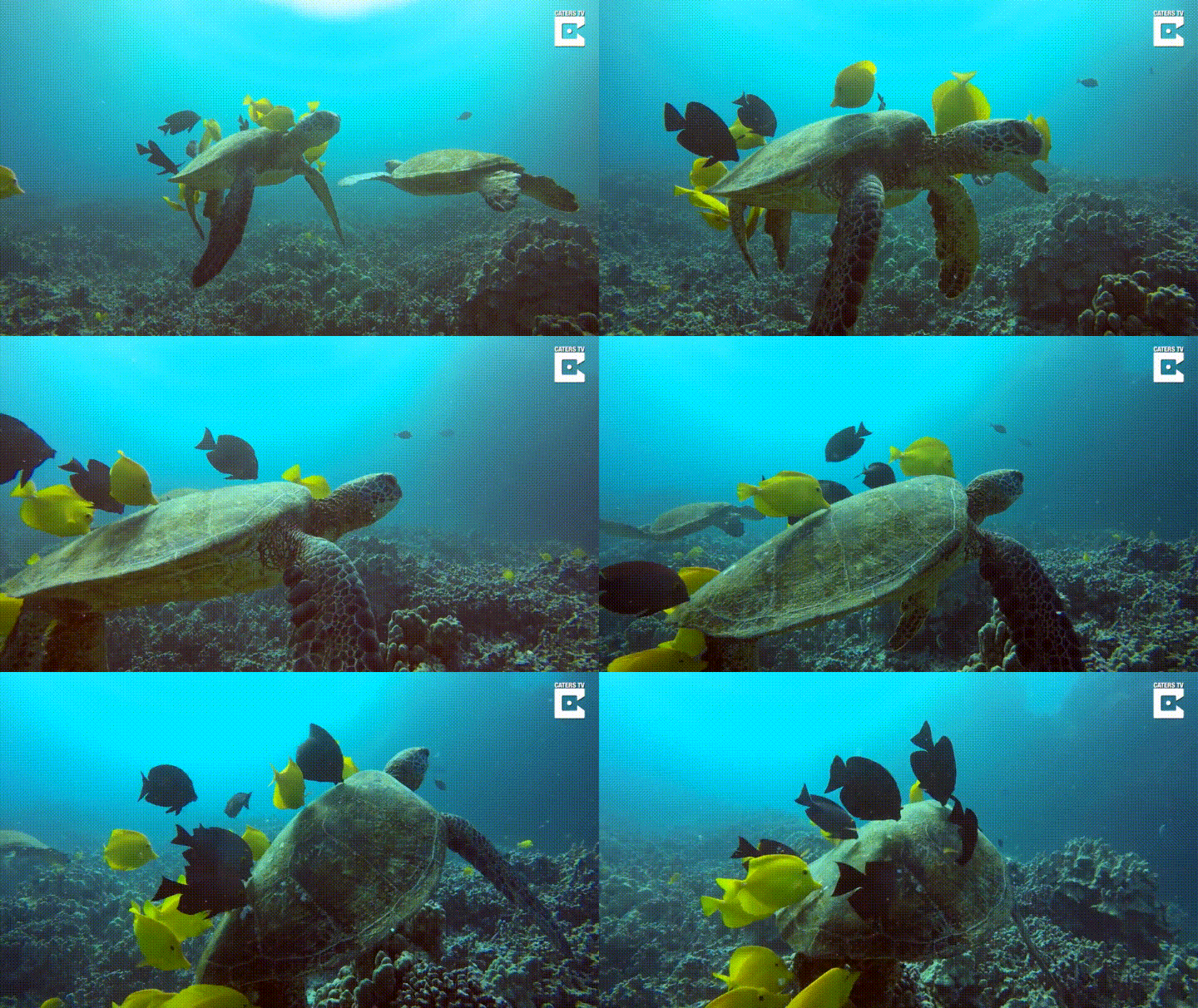
Gif of the week
Review of 2017
| "Surely we have a responsibility to care for our blue planet. Along with 17 million others, I ended my 2017 watching in awe as Sir David Attenborough and the Blue Planet II team showed us spellbinding images of an underwater world “beyond our imagination". I chuckled as king penguins waddled their way through hordes of high-strung elephant seals, and stared with my mouth agape as a giant trevally launched itself from the water to swallow a fledgling tern whole. The series brought the wonders of the ocean into our living rooms, capturing the public imagination as never before. I nonetheless worried that the show painted too rosy a picture of an ocean we know to be in grave danger. There were hints in each episode. I felt a pang of deep sadness as a mothering seal struggled to find a safe space for her pup amidst the retreating sea ice. I sobbed as a pilot whale refused to part with her dead calf even days after its death. In the finale, Sir David did not hold back as he raised the alarm: Blue Planet II was an extraordinary ode to the beauty of our ocean and a stark reminder of the challenges that lie ahead. The series was also a fitting end to a year of unprecedented action for the ocean - if 2017 was the year the ocean entered into the public consciousness, it might also be remembered as the moment the tide started to turn. Life in plastic, not so fantastic Sir David Attenborough was at primary school when we entered the era of plastic. His recalls his science teacher and headmaster exclaiming, "It doesn’t decay, you know, it’s wonderful!" We've since created 8,300 million metric tons of the stuff, with 80% of it ending up in landfill, littering our streets, and polluting the seas. Plastic is now turning up everywhere: fish, sea salt, tap water, and even the deepest reaches of the ocean. Banning plastic bags was only the start. Seattle is banning single-use plastic straws and cutlery, while residents of one Welsh village are aiming to phase out single-use plastics altogether. Indonesia is one of the countries thinking big, pledging $1bn to tackle the problem, while UN Environment has declared “war on ocean plastic”. Global brands like Unilever are starting to make some inroads, and Adidas and Stella McCartney are using yarn made from marine litter to turn pollution into fashion. Marine plastic pollution in Singapore © Vaidehi Shah The ocean on the international stage The ocean made a big splash on the international stage this year. The UN appointed a Special Envoy for the Ocean and held a huge international Ocean Conference at its New York headquarters, where leaders and government representatives said they are "determined to act decisively and urgently" (see the Call for Action). At the Our Ocean conference in Malta, they put their money where their mouth is, making financial pledges worth €7.2 billion. (Prince Charles was there, but, more importantly, the conference also saw the founding of Little Blue Letter!) The ocean was also more visible than ever at the annual climate shindig in Bonn, with co-hosts Fiji working hard to put the ocean on the climate agenda. Coral grief Ocean lovers worldwide despaired this year as Australia's Great Barrier Reef continued to suffer from catastrophic bleaching. The Queensland Government has banned coal-ship loading on the reef, but the Federal Government has approved the country's largest ever coal mine, which would ship coal from a port right on the reefs doorstep. Coral spawning Writing the reefs obituary may be premature, but they could be gone within the century as CO2 emissions make the seas warmer and more acidic. It is hard to find hope here, but efforts to breed coral and help them spawn are showing promise, while some areas appear to be surprisingly resilient in the face of overwhelming threats.Bleached Acropora coral (foreground) and normal colony (background) Keppel Islands, Great Barrier Reef A new age of exploration Each year, fascinating new scientific studies shed light on what lurks beneath. This year we learnt that oysters are sensitive to noise, found a deformed dolphin living with a pod of friendly sperm whales, and discovered new sponge species in the pacific (in the Clarion Clipperton Zone, an area slated for seabed mining). Meanwhile, the UN declared 2021-2030 to be the "Decade of Ocean Science for Sustainable Development", aiming to boost research efforts and inspire a new generation of marine scientists. Oh and Boaty McBoatface completed its first mission! Boaty McBoatface in the water Hope for the high seas? After more than 10 years of discussions, States have agreed to negotiate a new legally binding treaty for the high seas (i.e. half the planet). Most countries have expressed their support, but negotiations will be fraught. Conservation-minded countries want to create MPAs, but some are reluctant to impose new restrictions. There are complex issues regarding the use of marine genetic resources (i.e. genes extracted from marine species and used to develop pharmaceuticals and cosmetics). Everyone agrees we should conduct environmental impact assessments for human activities on the high seas, but it isn’t clear how this will work in practice. Meanwhile, developing countries argue that they can't properly participate unless a new agreement helps build their capacity Poles apart It was a mixed year for the Arctic and Antarctica. Winter Arctic sea ice dropped to the lowest ever recorded level, with scientists fearing that even meeting global climate targets is insufficient. And of course, plastic has found its way to the furthest northern reaches of our planet too. But it wasn't all bad news. The International Maritime Organisation adopted the Polar Code, setting out new rules for ships crossing the polar regions. Nine countries and the EU agreed to ban commercial fishing in the Arctic for at least 16 years, giving scientists time to conduct important research before fishing becomes widespread. The Ross Sea marine protected area (MPA) just came into force, having been agreed upon following intense diplomatic discussions at the meeting of the Convention on the Conservation of Antarctic Marine Living Resources (CCAMLR) last year. Unfortunately, States failed to maintain the momentum at this year's meeting, as negotiations for further MPAs fell apart. Iceberg off Trinity Island, Antarctic Peninsula © Kelvin Trautman Bouncing back? Conservation efforts seem to be helping sea turtles, with a study suggesting that they are bouncing back. Others, like the highly endangered Vaquita, have not been so lucky - there are now just 30 left in the wild. Members of the International Commission for the Conservation of Atlantic Tunas (ICCAT) decided to increase the catch quota for Bluefin tuna, going against scientific advice and putting long-term recovery of the stock at risk. The news from the meeting of the Convention on Migratory Species was more positive, with Parties moving to protect six shark and ray species. 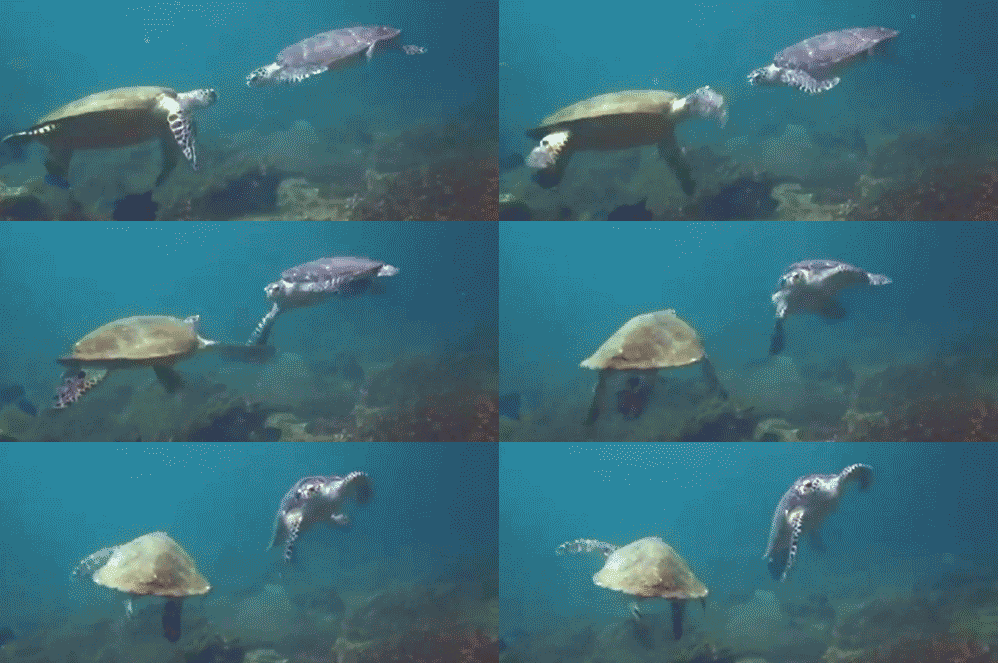 Look to the (blue) future Even as the ocean faces immense pressures from all angles, humans continue to look to the 'Blue Economy' for economic growth. Many countries are heavily investing in fish farming and tourism, while offshore wind has moved into the mainstream. Development of wave and tidal energy requires careful consideration if it is to provide energy without harming the environment, while seabed mining inches ever closer to fruition, despite the risks and scientific uncertainty. Microsoft has even produced a prototype of an underwater data centre that uses the sea to cool energy intensive servers. (Google has already patented a similar system, powered by wave energy). Conserve and protect The trend for declaring huge MPAs continued in 2017. Chile declared an MPA almost as big as the country itself around Easter Island, banning extractive industries and industrial fishing. Mexico put an area the size of Illinois off limits for fishing and other extractive activities, protecting the pristine and productive shark-infested waters around a small group of islands 400km off the country's Pacific coast (an abundance of sharks is a good thing, honestly). The island I call home is relatively small, so it is hard to believe that the UK is custodian of the fifth largest marine estate in the world. Yet the vast waters around our remote Overseas Territories are home to the planet's largest coral atoll and as much as a quarter of its penguins. Conservationists are now lobbying the government to create a “blue belt” around these islands, allowing ocean ecosystems to recover and marine life to thrive. Silky sharks prowling the Mexican coast It's only just begun... While it is possible to find glimmers of hope in this time of unprecedented crisis, our life support system and its many inhabitants are going to need far more help if they are to survive and thrive. If 2017 was the moment the tide started to turn, 2018 must be the year we take action. An ocean in crisis needs more than "paper parks" and promises. |
Little Blue Letter was written this week by Glen Wright. Glen is a researcher studying marine governance, the high seas, and ocean energy. He is a drinker of tea, lover of the sea, and an Oxford comma user. Glen recently published Academia Obscura: The Hidden Silly Side of Higher Education.
Little Blue Letter is a splash of uplifting ocean stuff, lovingly curated by young ocean leaders and shipped straight to your inbox every Friday. Pass it on, encourage other ocean lovers to sign up, and follow on Twitter.
Enjoy Reading This Article?
Here are some more articles you might like to read next: