
Hello 👋🏻
I’m Glen, a researcher, writer, facilitator and workshoppera with expertise in oceans and energy.
This work-in-progress website is an attempt to gather all my bits & bobs into a semi-organised body of work and share my side-projects and cut-and-paste creations.
Please get in touch, ask me anything, tell me a secret, offer me money in exchange for my labour, or just say hi :)
I’m a non-lawyer with two law degrees and an abandoned almost-finished PhD (that instead became a book). During my meandering 15-year career, I drifted from energy policy to ocean conservation and back again, with currents of research, policy analysis, community building, campaigning, science communication and, more recently, data collection, analysis, and visualisation.
When I first learned about climate change (382 ppm), I couldn’t understand why we weren’t panicking and tried to build a career that could contribute to humanity’s course correction. As of 442 ppm, that panic has matured into an ever-present climate anxiety, albeit with a stubborn streak of hope.
I dedicated just over a decade to the development of the UN High Seas Treaty, writing the go-to guide to the negotiations (a Vatican diplomat once told me it was their Bible), slipping some not-formally-peer-reviewed musings into Nature, and contributing a whole bunch of papers and presentations to the effort to put the global ocean on the agenda.
In my most recent “proper job” I updated my expertise on energy working on the Renewables Global Status Report and providing data-driven evidence in support of the energy transition. I also got to expand and stress-test my tech credentials, renovating aging data infrastructure, building databases, and overhauling and automating workflows and production processes. In my final chapter, I threw the full range of my skills and compassion into organisational transformation as a leader, facilitator, mentor, and advocate for staff.
Being a professor of Marine Policy & Ocean Governance at Sciences Po has kept my toes in the water, and I continue to teach and learn with a passionate curiosity for all things ocean.
Some special interests include:
- Being an under-the-radar computer nerd and avid AI amateur: tinkering with Raspberry Pis, building artisanal vibe-coded tools and automations, and fine-tuning large language models on a hand-crafted home server.
- A borderline obsession with basketball (I decided to follow a random sport/team for a year just to see what all the fuss was about and fell down a rabbit hole). I am writing a book tentatively titled Hoops: An Uncommon Guide to the Game of Basketball.
- Collage, the original cut-and-paste, which may or may not be art.
- Poetry (having realised that poems are just word collages and that my near-daily journalling could be shorter and prettier).
- Neuroscience, psychology, pharmacology, neuropsychopharmacology.
- Being two short steps away from an anti-capitalist rant at any given moment. While I keep an open mind (strong opinions, lightly held), I’m increasingly convinced we’ll need some mix of wealth taxes, universal basic income, job guarantees, and post-growth economic policies.
selected publications
-
 Renewables 2025 Global Status Report: Global Overview (2025)
Abstract
In 2024, global renewable energy growth was primarily driven by the power sector, where capacity expanded by 741 gigawatts (GW), the largest annual increase ever recorded. Solar photovoltaics (PV) led this growth, supported by rapidly falling costs, large-scale deployments and mature supply chains; however, growth in wind energy installations slowed. Deployment of battery storage hit record levels, driven by falling prices and growing recognition of storage as critical for grid reliability. Despite this momentum, renewable energy growth could not keep pace with rising global electricity demand. Growth in electricity demand was driven by higher temperatures, industrial expansion and rapid electrification in emerging markets. Data centres consumed large amounts of electricity as use of artificial intelligence (AI) technologies continued to grow. Renewables were deployed to meet some of this demand, and fossil fuels filled the gap. Global energy-related carbon dioxide (CO2) emissions increased 0.8% compared to 2023. The year 2024 was the hottest on record, and for the first time the global average temperature exceeded 1.5 degrees Celsius ( degreesC) above pre-industrial levels over a full calendar year. Climate impacts intensified worldwide: Los Angeles (United States) faced severe wildfires, Valencia (Spain) experienced extreme flooding, droughts hit Latin America, and flash floods inundated the Caribbean. These events disrupted communities, economies, and energy systems, with vulnerable regions suffering the most. This series of disasters again emphasises that the climate emergency is not a future threat it is already disrupting lives and livelihoods across the planet. Energy security remained in the spotlight in 2024, as geopolitical tensions, trade disruptions and rising economic nationalism influenced national energy strategies. Countries sought to secure supply, reduce external dependencies and control prices. While some countries accelerated their investments in renewables and energy storage to reduce risk and increase resilience, fossil fuel investments also grew, often driven by industrial lobbying and short-term security concerns. As these developments underscore, the energy transition is shaped not only by technical and economic factors, but also by political and governance choices, domestic pressures and competing visions of national interest. Renewable energy is no longer just a climate solution; it is essential infrastructure. In a world of intersecting crises, renewables support sustainable economic development, public health and energy security.
-
 Getting beyond yes: fast-tracking implementation of the United Nations agreement for marine biodiversity beyond national jurisdiction (2022)npj Ocean Sustainability
Abstract
With a new international agreement on the conservation and sustainable use of marine biodiversity of areas beyond national jurisdiction (BBNJ Agreement) on the horizon, now is the time to start laying the foundation for successful implementation. This paper provides some initial reflections for supporting rapid, effective, and equitable implementation of the BBNJ Agreement in three priority areas: (1) bringing the Agreement into force; (2) establishing the institutional framework, including financial mechanisms; and (3) developing capacity, science, and technology. With reference to selected examples from other international processes, the paper makes suggestions for encouraging wide ratification of the BBNJ Agreement, establishing a Preparatory Commission (PrepCom), mobilizing resources, and building partnerships to advance science and capacity. The growing impacts of climate change and human activities on the global ocean necessitate urgent action, so we must begin to work on the implementation of the BBNJ Agreement as soon as possible to secure ocean health for the benefit of present and future generations.
-
 Rights of Nature: Perspectives for Global Ocean Stewardship (2020)Marine Policy
Abstract
The development of a new international legally binding instrument for the conservation and sustainable use of marine biodiversity beyond national jurisdiction (BBNJ agreement) is in the final negotiation phase. Legal recognition of rights of nature is emerging worldwide as a fresh imperative to preserve ecological integrity, safeguard human wellbeing, broaden participation in decision-making, and give a voice to nature - but so far exclusively within national jurisdiction. In this paper, we consider how a Rights of Nature perspective might inform the BBNJ agreement. We examine Rights of Nature laws and identify four characteristics relating to: i) rights; ii) connectivity; iii) reciprocity; and iv) representation and implementation. We argue that a Rights of Nature perspective can reinforce existing ocean governance norms, inspire new measures to enhance the effectiveness and equitability of the BBNJ agreement and enable global ocean stewardship in ABNJ.
-
 High Hopes for the High Seas: beyond the package deal towards an ambitious treaty (2019)
Abstract
Cognisant of the growing threats to biodiversity in marine areas beyond national jurisdiction (ABNJ), States at the United Nations are negotiating a treaty to ensure the conservation and sustainable use of this vast global commons. These negotiations provide a unique and timely opportunity to strengthen the management regime for the global ocean, building on the vision of the UN Convention on the Law of the Sea (UNCLOS). The treaty will cover a ‘package deal’ of issues: marine genetic resources (MGRs); area-based manage- ment tools (ABMTs), including marine protected areas (MPAs); environmental impact assessments (EIAs); and capacity building and technology transfer. In order to be effective, ambitious provisions are needed on each of these elements, including by addressing climate change and ensuring the protection of marine ecosystems. A fair and equitable treaty could further support conservation and sustainable use by strengthening existing management frameworks and providing global oversight, developing capacity, and placing science at the heart of decision making.
-
 High-seas fish biodiversity is slipping through the governance net (2019)Nature Ecology & Evolution
Abstract
States at the United Nations have begun negotiating a new treaty to strengthen the legal regime for marine biodiversity in areas beyond national jurisdiction. Failure to ensure the full scope of fish biodiversity is covered could result in thousands of species continuing to slip through the cracks of a fragmented global ocean governance framework.
-
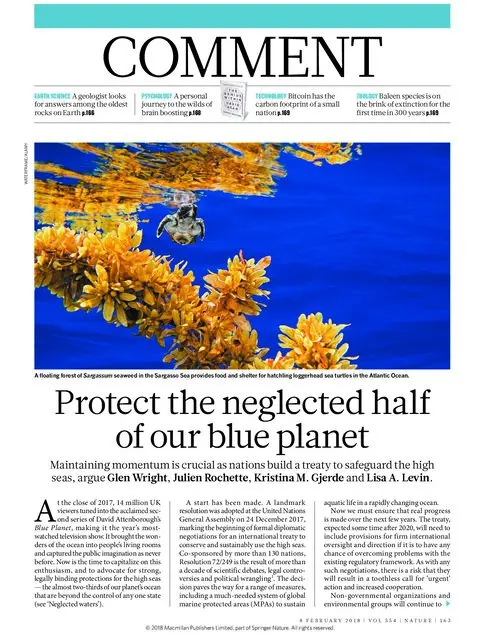 Protect the neglected half of our blue planet (2018)Nature
Abstract
At the close of 2017, 14 million UK viewers tuned into the acclaimed second series of David Attenborough’s Blue Planet, making it the year’s most-watched television show. It brought the wonders of the ocean into people’s living rooms and captured the public imagination as never before. Now is the time to capitalize on this enthusiasm, and to advocate for strong, legally binding protections for the high seas - the almost two-thirds of our planet’s ocean that are beyond the control of any one State.
-
 The Long and Winding Road: negotiating a treaty for the conservation and sustainable use of marine biodiversity in areas beyond national jurisdiction (2018)
Abstract
Marine areas beyond national jurisdiction (ABNJ) cover nearly half of the Earth’s surface and host a significant portion of its biodiversity. The international community, increasingly aware of the growing threats to ecosystems in ABNJ, has been informally discussing options to conserve and sustainably use its biodiversity for more than a decade. On 24 December 2017, the United Nations General Assembly (UNGA) decided to convene an intergovernmental conference (IGC) to elaborate an international legally binding instrument (ILBI) for the conservation and sustainable use of the biological diversity of ABNJ. As States continue to navigate the complex issues at stake and start to negotiate the provisions of a new agreement, it is imperative that all stakeholders have a clear and comprehensive understanding of the history of the process, elements under discussion, State positions to date, and the challenges that lie ahead. The Long and Winding Road provides a guide to the discussions for both experienced participants and newcomers to the process.


