17 November 2018 — Wetlands in the world spotlight
Sent 17 November 2018. Part of Little Blue Letter.

"A marsh is a whole world within a world, a different world, with a life of its own,
with its own permanent denizens, its passing visitors,
its voices, its sounds, its own strange mystery."
with its own permanent denizens, its passing visitors,
its voices, its sounds, its own strange mystery."
~ Guy de Maupassant
Wetlands in the world spotlight
The Ramsar Convention on Wetlands - an intergovernmental treaty that provides a framework for national action and international cooperation for the conservation and wise use of wetlands and their resources - recently met in Dubai. The Convention was established over 40 years ago to protect wetlands around the world and there are now more than 2,000 Ramsar-designated wetlands that represent rare or unique habitats important for conserving biological diversity.
 The Convention just issued the first-ever global report on the state of the world's wetlands, finding that about 35% of the planet’s wetlands were lost between 1970 and 2015. This is concerning as wetlands mitigate floods, protect coastlines and build community resilience to disasters, and play an important role in transport, tourism and culture. They are also a vital source of food (60%-90% of U.S. commercial fisheries depend on wetlands) and provide the largest terrestrial carbon store.
Around the world people are helping us understand the value of wetlands in order to develop better ways of protecting and restoring these important habitats. Recently, a team of interdisciplinary researchers (including the insurance industry!) calculated the financial benefits that coastal wetlands provide by reducing damages from hurricanes and offers new evidence that protecting natural ecosystems is a cost-effective way of reducing risks from flooding. Another team of researchers suggests the idea of “Wetland Restoration Brokers” - independent mediators that could help settle conflicts among stakeholders or between stakeholders and the environment. And the Ramsar Convention itself has launched accreditation for cities that conserve wetlands, with 18 cities around the world so far recognized.
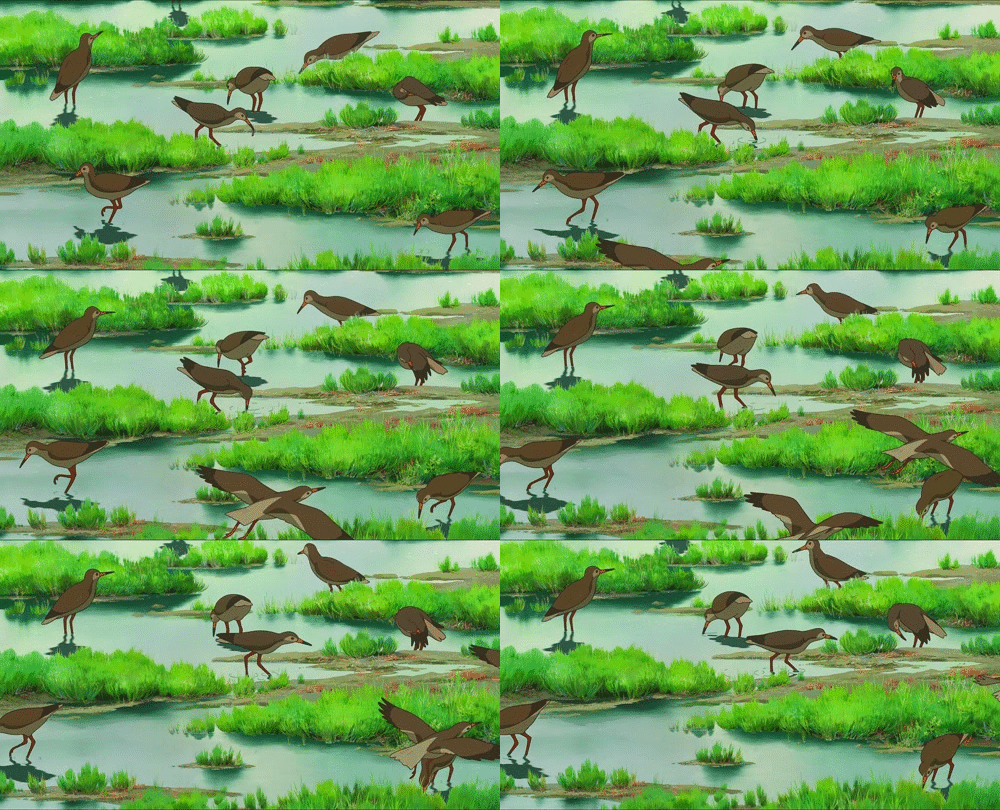
Gif of the week

#OceanOptimism
More on wetlands
From the editor
Sorry for the delays in posting folks!
 Little Blue Letter was curated this week by Katie O’Reilly. Katie is a Ph.D. candidate at University of Notre Dame studying coastal wetlands and is currently a NOAA Sea Grant Knauss Marine Policy Fellow in Washington, D.C..
 Editing etc. by Glen Wright. Glen is a researcher studying marine governance, the high seas, and ocean energy. He is a drinker of tea, lover of the sea, and an Oxford comma user. Glen recently published Academia Obscura: The Hidden Silly Side of Higher Education.
Little Blue Letter is a splash of uplifting ocean stuff,
lovingly curated by young ocean leaders
and shipped straight to your inbox every Friday.
Sign up, pass it on, follow on twitter, or write an edition.
🌊🌊🌊
The Ramsar Convention on Wetlands - an intergovernmental treaty that provides a framework for national action and international cooperation for the conservation and wise use of wetlands and their resources - recently met in Dubai. The Convention was established over 40 years ago to protect wetlands around the world and there are now more than 2,000 Ramsar-designated wetlands that represent rare or unique habitats important for conserving biological diversity.
The Convention just issued the first-ever global report on the state of the world's wetlands, finding that about 35% of the planet’s wetlands were lost between 1970 and 2015. This is concerning as wetlands mitigate floods, protect coastlines and build community resilience to disasters, and play an important role in transport, tourism and culture. They are also a vital source of food (60%-90% of U.S. commercial fisheries depend on wetlands) and provide the largest terrestrial carbon store.Around the world people are helping us understand the value of wetlands in order to develop better ways of protecting and restoring these important habitats. Recently, a team of interdisciplinary researchers (including the insurance industry!) calculated the financial benefits that coastal wetlands provide by reducing damages from hurricanes and offers new evidence that protecting natural ecosystems is a cost-effective way of reducing risks from flooding. Another team of researchers suggests the idea of “Wetland Restoration Brokers” - independent mediators that could help settle conflicts among stakeholders or between stakeholders and the environment. And the Ramsar Convention itself has launched accreditation for cities that conserve wetlands, with 18 cities around the world so far recognized.
Gif of the week
#OceanOptimism
- California Governor Jerry Brown signed a law to phase out the use of destructive swordfish gillnets. The bill had broad bipartisan support, passing the State Assembly unanimously and the State Senate by a vote of 36-1 before being sent to the governor’s desk.
- The European Parliament has voted for a complete ban on a range of single-use plastics across the union in a bid to stop pollution of the oceans.
- Researchers discover the world's largest deep-sea octopus nursery with over 1,000 females.
More on wetlands
- Why a wetland might not be wet: Most Australian wetlands have natural wet-dry cycles, with dry spells that can last for decades. So, if wetlands are still wetlands when they're dry, how do you spot one?
- Impacts of human‐induced environmental change in wetlands on aquatic animals: a review of the ecological impacts of human alterations to wetland ecosystems.
- NOAA’s National Estuarine Research Reserve System is comprised of 29 sites designated to protect and study estuarine systems, including a Ramsar-designated wetland (California’s Elkhorn Slough), one of 39 Ramsar sites in the United States.
From the editor
Sorry for the delays in posting folks!
Little Blue Letter was curated this week by Katie O’Reilly. Katie is a Ph.D. candidate at University of Notre Dame studying coastal wetlands and is currently a NOAA Sea Grant Knauss Marine Policy Fellow in Washington, D.C..Editing etc. by Glen Wright. Glen is a researcher studying marine governance, the high seas, and ocean energy. He is a drinker of tea, lover of the sea, and an Oxford comma user. Glen recently published Academia Obscura: The Hidden Silly Side of Higher Education.Little Blue Letter is a splash of uplifting ocean stuff,
lovingly curated by young ocean leaders
and shipped straight to your inbox every Friday.
Sign up, pass it on, follow on twitter, or write an edition.
🌊🌊🌊
Enjoy Reading This Article?
Here are some more articles you might like to read next: