Protecting Earth's last conservation frontier: scientific, management and legal priorities for MPAs beyond national boundaries
1. Marine areas beyond national jurisdiction (ABNJ) comprise most of Earth's interconnected ocean, hosting complex ecosystems that play key roles in sustaining life and providing important goods and s...
Abstract
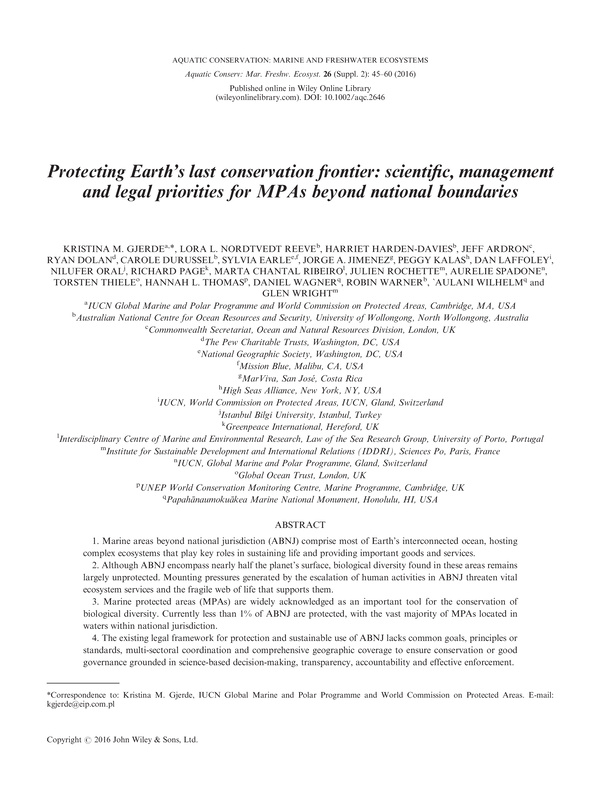
- Marine areas beyond national jurisdiction (ABNJ) comprise most of Earth’s interconnected ocean, hosting complex ecosystems that play key roles in sustaining life and providing important goods and services. 2. Although ABNJ encompass nearly half the planet’s surface, biological diversity found in these areas remains largely unprotected. Mounting pressures generated by the escalation of human activities in ABNJ threaten vital ecosystem services and the fragile web of life that supports them. 3. Marine protected areas (MPAs) are widely acknowledged as an important tool for the conservation of biological diversity. Currently less than 1%\ of ABNJ are protected, with the vast majority of MPAs located in waters within national jurisdiction. 4. The existing legal framework for protection and sustainable use of ABNJ lacks common goals, principles or standards, multi-sectoral coordination and comprehensive geographic coverage to ensure conservation or good governance grounded in science-based decision-making, transparency, accountability and effective enforcement.5. This paper highlights the urgency and importance of protecting the last conservation frontier on Earth. Key lessons for conservation inABNJ can be learned fromregional, cross-boundary and national experiences shared during the high seas governance workshop at the IUCNWorld Parks Congress in Sydney, Australia in November 2014. 6. The intent of this paper is to inform the deliberations now underway in the United Nations General Assembly to develop a new legally binding international instrument for the conservation and sustainable use of marine biological diversity in ABNJ. It also aims to encourage further initiatives to protect and preserve our last conservation frontier using currently available mechanisms and powers consistent with international law.
Publication Details
Authors: Kristina M. Gjerde, Lora L. Nordtvedt Reeve, Harriet Harden-Davies, Jeff Ardron, Ryan Dolan, Carole Durussel, Sylvia Earle, Jorge A. Jimenez, Peggy Kalas, Dan Laffoley, Nilufer Oral, Richard Page, Marta Chantal Ribeiro, Julien Rochette, Aurelie Spadone, Torsten Thiele, Hannah L. Thomas, Daniel Wagner, Robin Warner, Aulani Wilhelm, Glen Wright, Lora L Nordtvedt, Harriet Harden-Davies, Jeff Ardron, San José, Costa Rica
Venue: Aquatic Conservation: Marine and Freshwater Ecosystems Year: 2016 Volume: 26 Pages: 45–60
Links and Resources

Keywords
reviw, ★, conservation, high seas, review, marine protected areas (mpas), 10.1002/aqc.2646 and marine areas beqyond national, bbnj:abnj, biological diversity conservation, international seabed area, marine areas beqyond national jurisdiction (abnj), new legally-binding instrument under the united na, regional governance