Investigate a question and trace it back to evidence
Use TranscriptX as an analysis workbench: start from a question, follow results to supporting excerpts, then return to the transcript.
Outcome
You will have answered one concrete question about the sample meeting by moving from Overview through Insights into transcript evidence.
Starting point
The planning-review transcript is imported, speakers are preferably named (Identify and name speakers), and a Balanced (or richer) run is selected on Overview.
Example question: Where did the speakers disagree most about the launch plan?
What you’ll do
Orient on Overview.
Open Insights → Summary for themes and tension points.
Optionally open Insights → Highlights for denser quotes.
Jump back to Transcript for full context.
Form your own interpretation.
Walkthrough
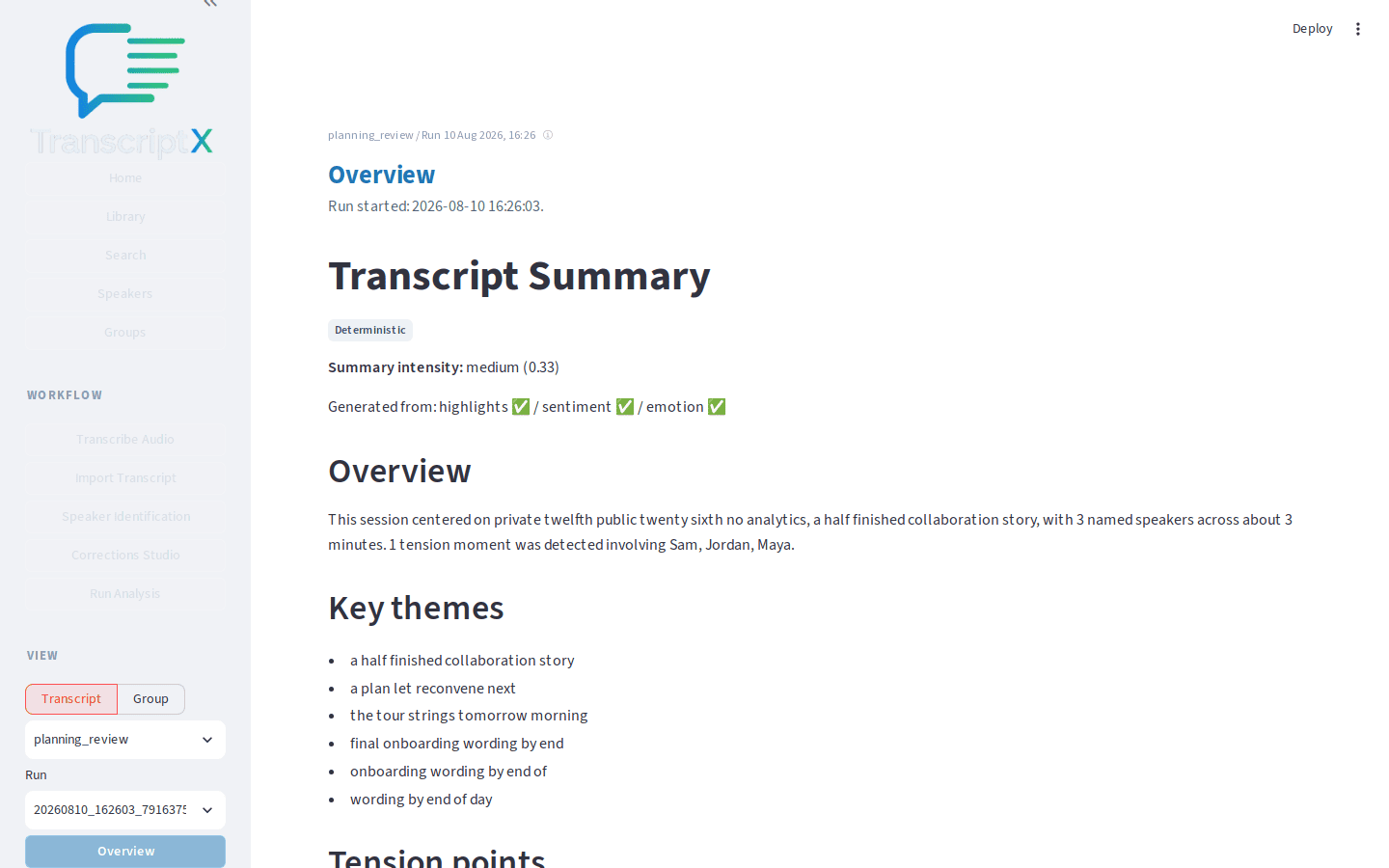
Keep the example question in mind. Open Overview for the planning-review run and scan the compact highlights and speaker cards for signs of disagreement (timeline, scope, analytics).
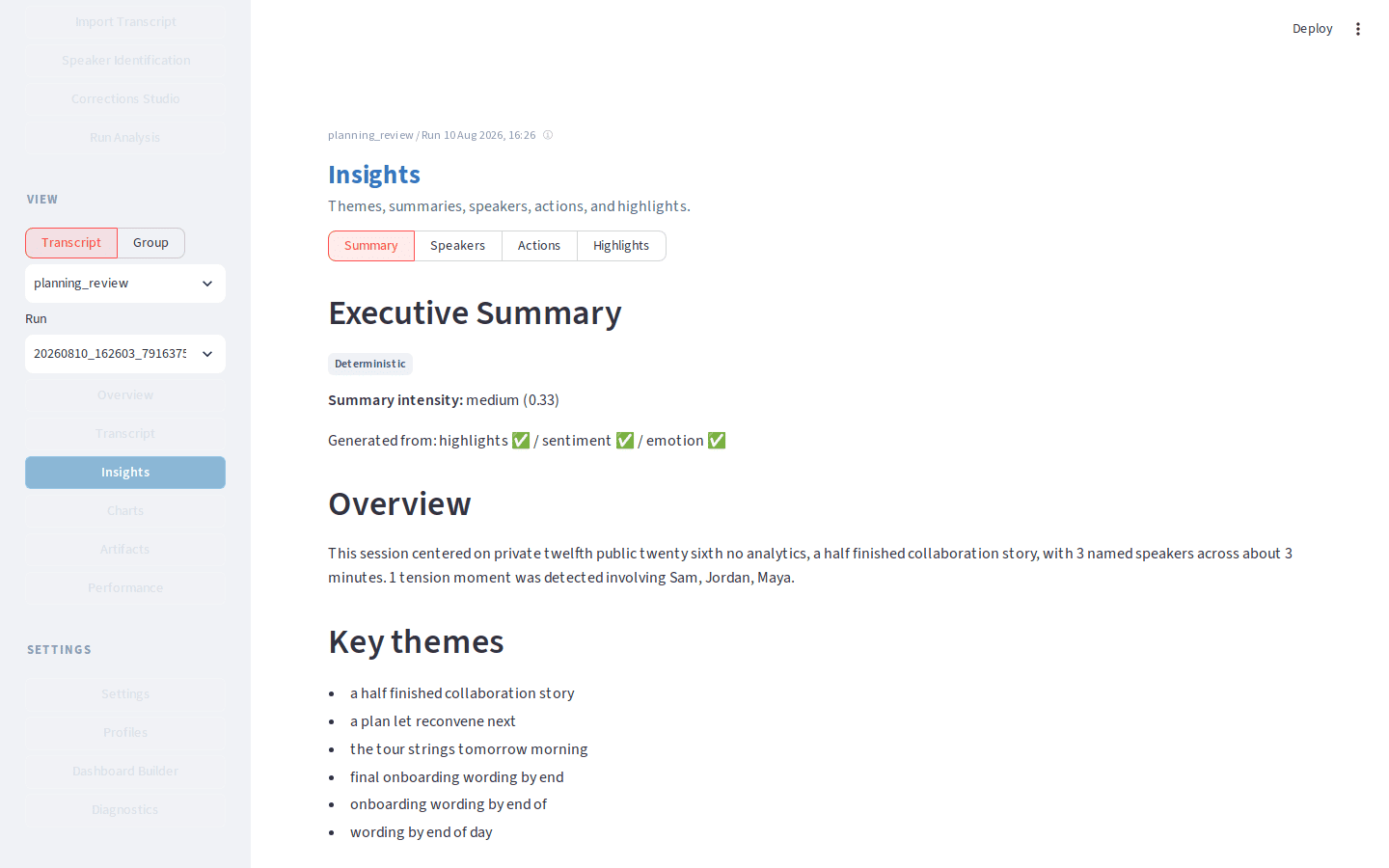
Open Insights and stay on the Summary section first. Read the executive overview, key themes, and any tension points — in this sample you should see disagreement around timeline, collaboration scope, and analytics.
Follow one tension point or theme quote into fuller context. Prefer a cited speaker line (for example Sam on analytics versus shared folders) and open Transcript to read the surrounding turns. Use Highlights only if you want a denser quote/tension list.
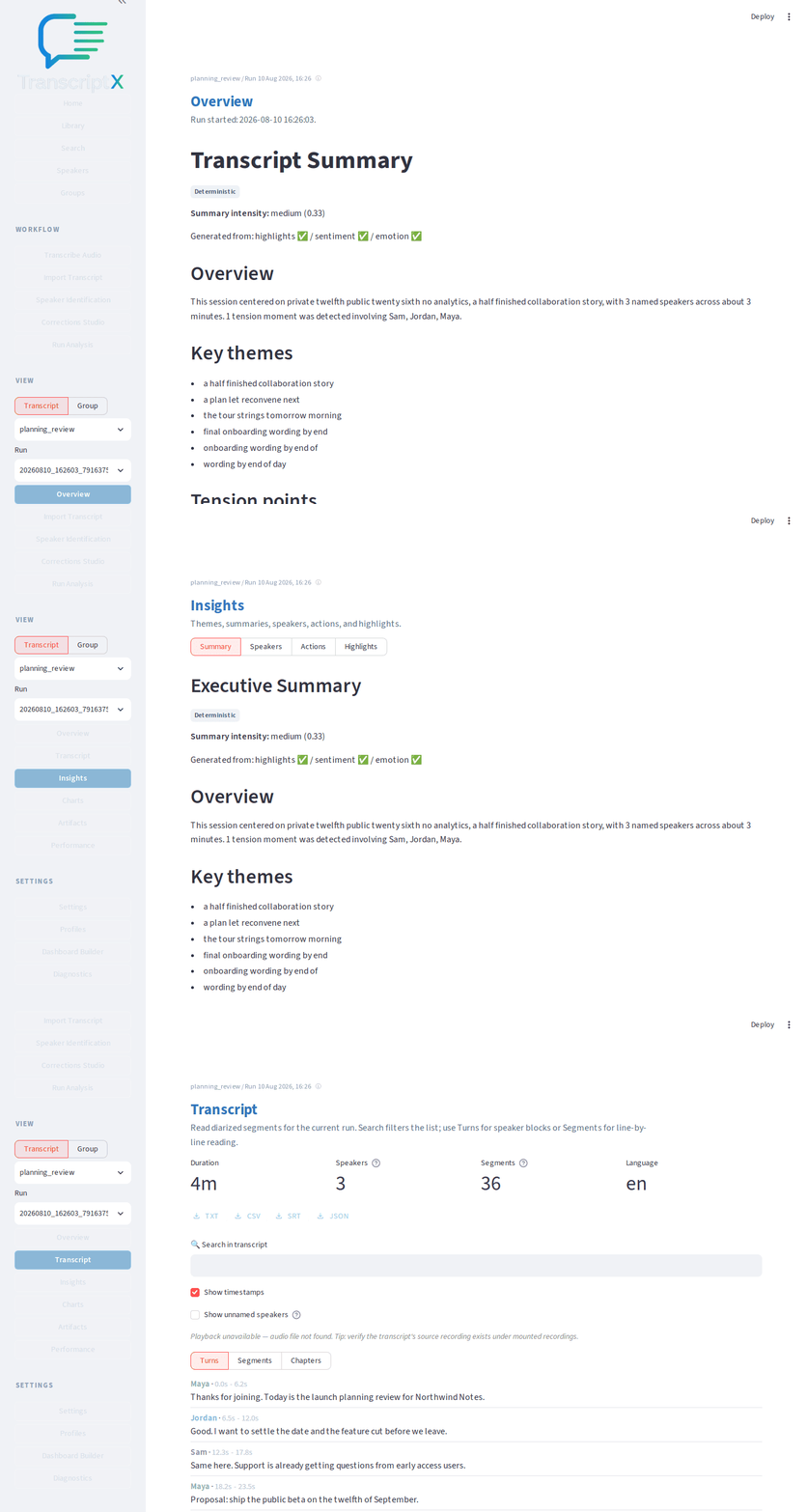
On Transcript, read a few turns before and after the cited segment. In this sample, the sharpest disagreement is timeline-versus-scope (ship on the twelfth versus delaying for offline sync), with a later disagreement about analytics in beta.
Optionally open Insights → Highlights for additional quote cards, then return to Transcript when you need evidence rather than labels.
Stop after you can answer the question in your own words with at least one cited stretch of dialogue. You do not need to open every Insights section or the full Charts gallery for this investigation.
What to notice
Progressive investigation beats touring every module.
Highlights and themes are aids to interpretation; they are not unquestionable conclusions.
Segment jumps preserve provenance: always re-read surrounding turns.
Partial or empty modules still leave the transcript as ground truth.
You should now have…
A short, evidence-backed answer to the launch-disagreement question, with a path you can reuse on your own transcripts.
Next
Use local AI for synthesis when you want a generated summary of the same run
Module catalog for deeper reference on individual analyses